
"AI" has become a broad enough label that it covers everything from a chatbot widget to a fully autonomous agent making business decisions. For most enterprises in Saudi Arabia evaluating where to spend their first (or next) AI budget, the highest-ROI opportunities tend to be narrower and less glamorous than the marketing around generative AI suggests — and that's a good thing, because narrower scope means faster delivery and clearer measurement.
Where the ROI is clearest
Document intelligence for high-volume, structured paperwork. Government and enterprise back-offices in the Kingdom process large volumes of invoices, contracts, ID documents, and compliance forms. Extracting structured data from these documents — rather than manual re-keying — is one of the most measurable AI investments available: time saved per document multiplied by document volume gives a direct, defensible ROI calculation before a single line of code is written.
Automation agents for repetitive, rules-based workflows. Processes like ticket triage, data reconciliation between systems, and routine approvals are well suited to automation agents that combine deterministic logic with AI for the parts that need judgement (e.g., classifying an unstructured request). These are lower-risk than open-ended generative AI because the scope of what the agent can do is constrained by design.
Computer vision for monitoring and inspection. In industrial, energy, and infrastructure contexts — relevant to KSA's ARAMCO ecosystem and critical infrastructure base — computer vision applied to existing camera or sensor feeds can automate inspection and anomaly detection tasks that are currently manual, slow, or inconsistent between shifts and sites.
Where to be more cautious
Customer-facing generative AI (chatbots, conversational agents) and anything touching regulated personal data carries more compliance overhead under SDAIA's PDPL and, in regulated sectors, SAMA or NCA requirements — particularly around where the underlying model processes data and what happens to conversation logs. These use cases can still have strong ROI, but the evaluation needs to include compliance design, not just the automation business case.
A simple way to evaluate AI ROI before committing budget
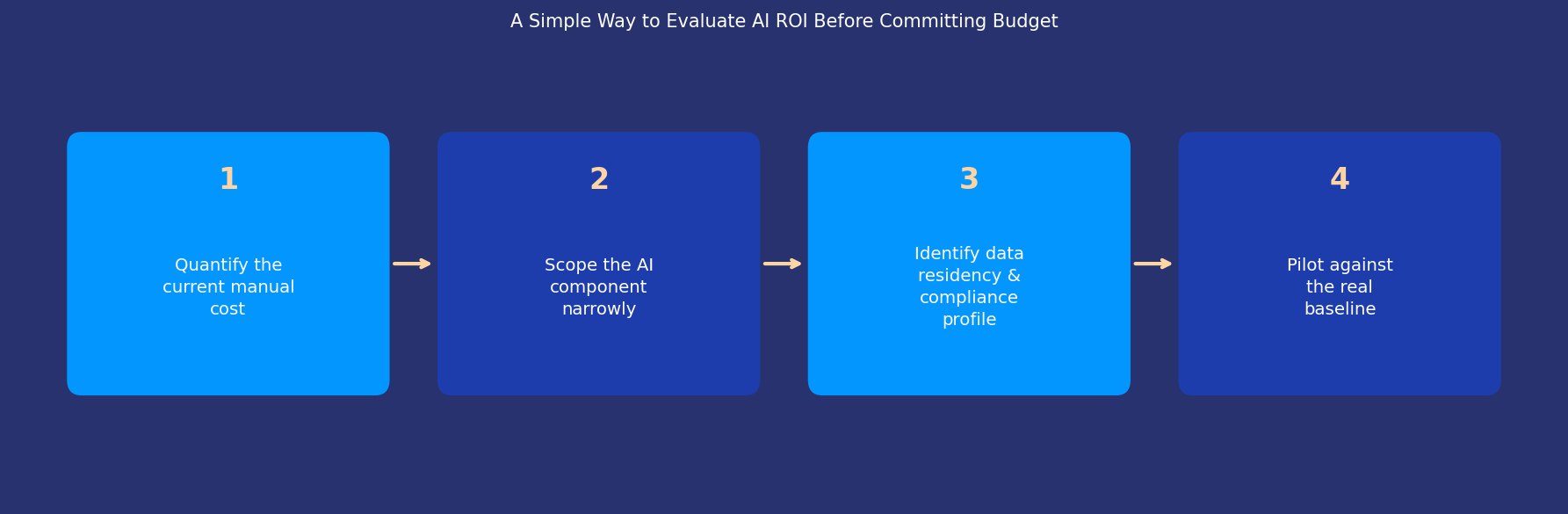
- Quantify the current manual cost — hours spent, error rate, or delay caused by the current manual process. This is the baseline the AI investment needs to beat.
- Scope the AI component narrowly. The most successful early AI projects automate one well-defined step, not an entire end-to-end process. Narrow scope means faster delivery and a cleaner before/after comparison.
- Identify the data residency and compliance profile up front. If personal or regulated data is involved, confirm where it will be processed before selecting a tool or model provider — retrofitting compliance after deployment is far more expensive than designing for it.
- Pilot against the baseline, not against an assumption. A short pilot measured against the real baseline from step 1 gives a far more reliable ROI figure than a vendor's general benchmark.
AI adoption in Saudi Arabia is accelerating under Vision 2030's digital economy goals, but the organisations getting the clearest returns are the ones starting with a specific, measurable business problem — not a general ambition to "use AI."