
Multi-cloud is usually adopted for resilience, negotiating leverage, or avoiding lock-in to a single hyperscaler. In Saudi Arabia, it carries an additional consideration that doesn't apply in most other markets in the same way: data sovereignty expectations driven by SDAIA's National Data Centre direction and sector-specific residency requirements from regulators like SAMA and the NCA.
This creates a real tension. The major global cloud providers — AWS, Microsoft Azure, and Google Cloud — all now operate in-Kingdom regions, which solves the residency problem for workloads kept within them. But a genuine multi-cloud strategy, by definition, often means moving data and workloads across providers and sometimes across borders for redundancy, analytics, or cost optimisation. Each of those movements needs to be evaluated against what data is involved, not assumed to be safe because the primary region is in-Kingdom.
A practical framework
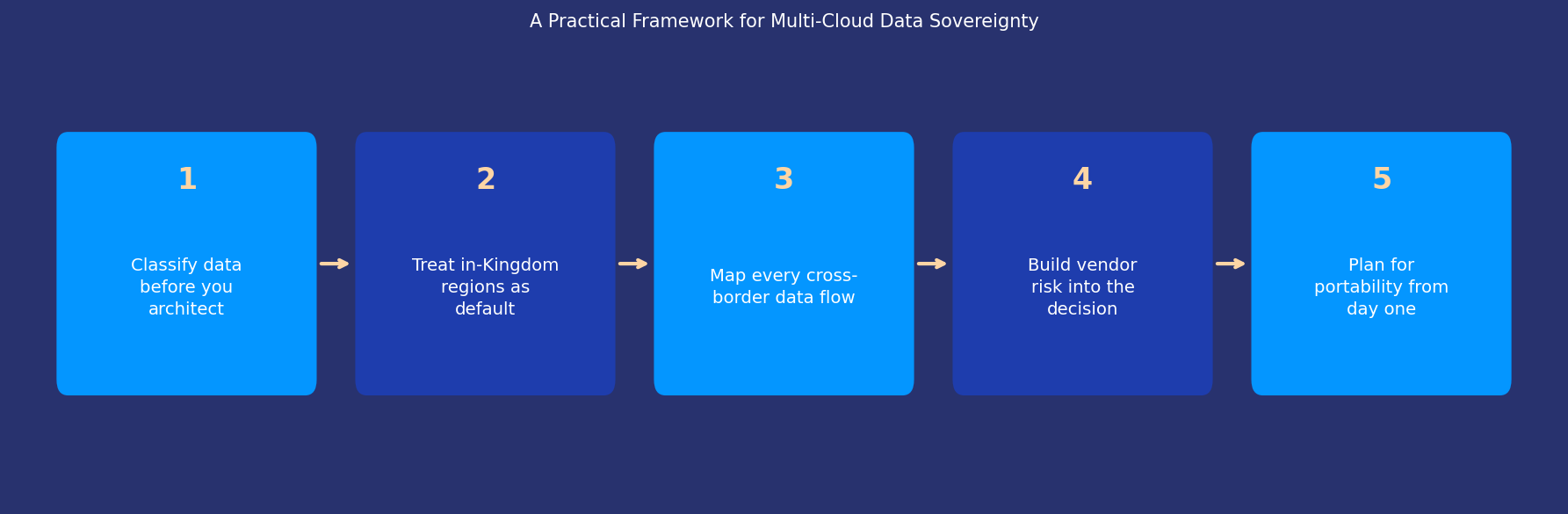
1. Classify before you architect. Not all workloads carry the same sensitivity. Government and regulated-sector data typically needs to stay in-Kingdom by default; general business applications may have more flexibility. Building a data classification map before choosing cloud architecture avoids retrofitting compliance after the fact.
2. Treat each provider's in-Kingdom region as the default, not the exception. With AWS, Azure, and Google Cloud all operating Saudi regions, there is rarely a good reason for sensitive workloads to default anywhere else. Multi-cloud resilience can still be achieved by running redundant in-Kingdom deployments across providers, rather than by replicating across borders.
3. Map every cross-border data flow explicitly. Backups, disaster recovery replication, support/diagnostic data, and SaaS integrations are the most common places data quietly crosses borders without an architecture decision being made. Each of these needs an explicit sign-off against PDPL's cross-border transfer rules, not a default vendor configuration.
4. Build vendor risk assessment into the multi-cloud decision, not after it. NCA ECC and the SAMA Cybersecurity Framework both place weight on third-party and outsourcing risk. A multi-cloud strategy that adds providers without updating the vendor risk register creates audit gaps that surface later, usually during a tender qualification or regulatory review.
5. Plan for portability from day one. Multi-cloud only delivers negotiating leverage and resilience if workloads are genuinely portable. Containerised workloads and infrastructure-as-code reduce the practical cost of moving a workload between providers' in-Kingdom regions if pricing, performance, or compliance requirements change.
The bottom line
Multi-cloud and data sovereignty are not in conflict in Saudi Arabia — but only if sovereignty requirements are designed in from the start rather than checked at the end. Enterprises that treat data classification and cross-border mapping as the first step of cloud architecture, rather than a compliance afterthought, end up with both better resilience and a far easier conversation with regulators and auditors.